

BTTZ cable is a rigid mineral-insulated cable with excellent fire resistance. Most commonly used mineral-insulated cables on the market are improvements on the standard fire resistance of BTTZ cables, which is why mineral-insulated cables are more expensive.
In building fire protection design codes, fire protection systems must use mineral-insulated cables. BTTZ is one type of mineral-insulated cable; others include YTTW, BTLY, and BBTRZ. It consists of a copper core, copper sheath, and magnesium oxide insulation, and is produced using a drawing process and annealing treatment. It is a true fire-resistant cable, capable of maintaining normal power supply for more than 3 hours at 950-1000°C in a fire.
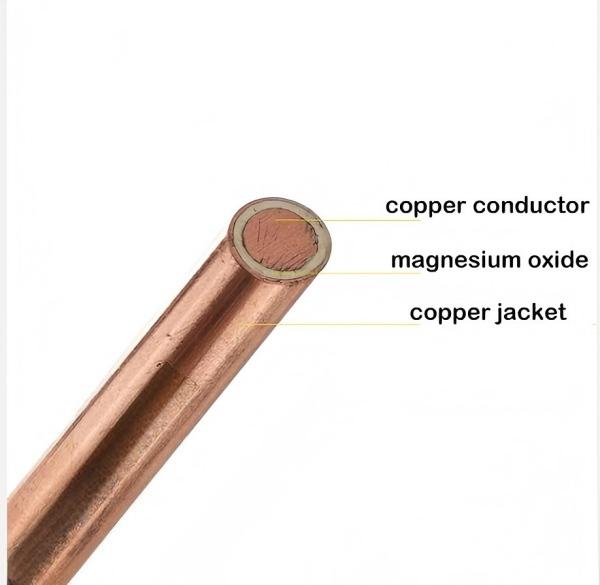
It features high temperature resistance, fire resistance, explosion resistance, non-combustibility (can operate continuously for extended periods at 250°C, and for short periods at 1000°C), high current carrying capacity, small outer diameter, high mechanical strength, and long service life. It generally does not require an independent grounding conductor.
2. Applications of BTTZ Cables
Widely used in hazardous, harsh, and high-temperature environments such as nuclear power plants, metallurgy, chemical plants, mines, and kilns. In recent years, they have been widely used in high-rise buildings, airports, docks, and subways to ensure uninterrupted operation of critical equipment such as fire-fighting power supplies, fire pumps, fire elevators, local lighting, emergency evacuation signs, security monitoring, smoke extraction systems, and backup power supplies during fires.
3. Advantages of BTTZ Cables
1) Completely fireproof: BTTZ cables are completely non-combustible and will not cause fires. Even when the flame temperature is below the melting point of copper, the cable will continue to function normally after the flame is extinguished.
2) Strong overload protection: Even when the circuit is overloaded, the cable will not be damaged as long as the temperature does not reach the melting point of copper.
3) High operating temperature: The magnesium oxide crystal insulation layer of BTTZ cables has a melting point much higher than that of copper, allowing for a normal operating temperature of up to 250℃.
4) Excellent corrosion resistance: The seamless copper tubing sheath is waterproof, moisture-proof, and resistant to chemical corrosion. The copper tubing also has explosion-proof properties.
5) Long service life: BTTZ cables are made entirely of inorganic materials, therefore there is no insulation aging, and the service life can be more than three times that of ordinary cables.
6) High corrosion resistance: The copper sheath has high corrosion resistance, so most equipment does not require additional protection measures. In areas where the cable copper sheath is susceptible to chemical corrosion or severe industrial pollution, a plastic outer sheath should be used for protection.
4. Disadvantages of BTTZ cables
1) High cost: The cable is made of special materials and contains more copper than ordinary cables, so the overall price is about 30% higher than ordinary cables.
2) Difficult construction: BTTZ is a rigid mineral-insulated cable, which has higher hardness and weight than ordinary cables, making construction more difficult.
3) Large workload: BTTZ cables with a diameter of 35mm or more are all single-core cables, which increases the number of intermediate joints and significantly increases the workload of construction.